

Forestry Sector in India
Forests cover 708,273 km2 or 21.54 percent of India’s land area (Forest Survey of India 2018).
India’s forests consist of a diverse range of forest types –
- Rainforests of the Western Ghats and northeastern states
- Coniferous hill forests of the Himalayas,
- Desert scrub and thorn forests of Rajasthan
Causes of Forest fires
Forest fires result from a combination of natural and social factors.
As shown in the triangle below, topography, weather, and fuel—the corners of the triangle—influence the potential for intensive fire behaviour and spread. At the centre of the triangle are people.

Impact of Forest fires
Positive Impact
- Many of India’s forests have evolved with fire and rely on fire to regenerate.
- Occasional fires can also keep down fuel loads that feed larger, more destructive conflagrations.
Negative Impact
The current pattern of fire is no longer beneficial to forest health. The following are the negative impacts of forest fires.
Ecological Impact
- Loss of forest cover, timber resources and associated economic cost
- Degradation of water catchment areas
- Reductions in biomass, species diversity, and natural regeneration
- Changes in micro-climate of the region and loss of forest cover also has impact on the global climate change
- Invasive species: forest fragmentation, along with forest fire make forest ecosystems more vulnerable to invasion by alien species
Economic Impact
- Monetary losses: Average damages reported per hectare in 2016 ranged from Rs 0 in Chhattisgarh to Rs 2344 in Himachal Pradesh.
- Underestimation of losses: However, monetary damages due to forest fires are generally assessed only for the loss of standing trees in terms of their timber value.
Social Impact
- Rural and tribal livelihoods depend on forests and forest products. Damage to forests grossly affects their livelihoods pushing them into poverty.
Strengthening Forest Fire Management in India
The Ministry of Environment, Forests and Climate Change (MoEFCC) and World Bank have recently released a report called “Strengthening Forest Fire Management in India”.
Objective of the Assessment:
To strengthen knowledge on forest fires by documenting current management systems, identifying gaps in implementation, and making recommendations on how these systems can be improved.
FFPM Process
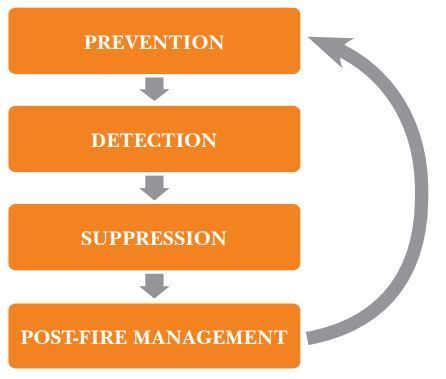
THE FOREST FIRE PREVENTION AND MANAGEMENT (FFPM) CYCLE
What did the Assessment Reveal?
- Forest fires in India are both widespread and concentrated
- Fire potential and behaviour is shaped by a combination of natural and social factors: Weather, fuels, and topography may influence fire potential and behaviour but virtually all forest fires are caused by people.
- The longer-term impacts and wider costs of forest fires are still poorly understood
- A vacuum exists at the level of national policy: Though MoEFCC had issued national guidelines on Forest Fire Management in 2000, they are no longer being implemented.
- Forest fire prevention is not being implemented consistently: Prevention is the most crucial link in the chain and should receive the greatest support
- India has developed robust detection systems for forest fires: Over the past decade, India has emerged as a leading example of how satellite technologies can be utilised for the detection and monitoring of forest fires.
- Well-equipped and well-trained people on the ground are essential to forest firefighting
- Post-fire management is not being treated as part of the FFPM process
- More effective engagement of forest-using communities is essential
- Coordination among agencies and institutions is required.
Way Forward
- Policy
- At the national level, a cohesive first-order policy or action plan can set forth the guiding principles and framework for FFPM, beginning with a clear statement of goals and priorities.
- The process should be open, consultative, clearly defined, and time-bound
- The national policy should also draw on climate change policies.
- Staffing, capacity, and management practices
- People on the ground are the key to effective fire suppression using dry techniques.
- The principal need is always to have a competent, trained, and equipped workforce on the ground, ready to respond and take immediate action.
- Forest fire prevention and management practices used by state forest departments also need to be strengthened.
- Technology
- Forest Survey of India has begun the development of systems for early warning and fire danger rating, and these efforts should be continued.
- Similarly, fire alert systems developed by FSI and the states should be strengthened further.
- Effective tools and technologies must satisfy local financial, social, and environmental constraints.
- Community Engagement
- The goal of FFPM should be to minimize the ecological, social, and economic impacts of fire while ensuring that the benefits reaped from fire may continue.
- Data and Information
- There is a need to support forest fire management through improved data, research to fill critical knowledge gaps, and regular knowledge exchange.
 UPSC CSE Notes